Ebook Free Brick: A World History By James W. P. Campbell, William Pryce
As known, basic publication does not mean simple message and also impact to get from guide. You could not be able to gauge just how value this Brick: A World History By James W. P. Campbell, William Pryce is unless you review and also finish it. When someone really feels that this publication is necessary, exactly what regarding you? Yeah, everyone will certainly have their own much-loved books. But, that's not fault to attempt reviewing various other book to improve the perception and also minds about something.
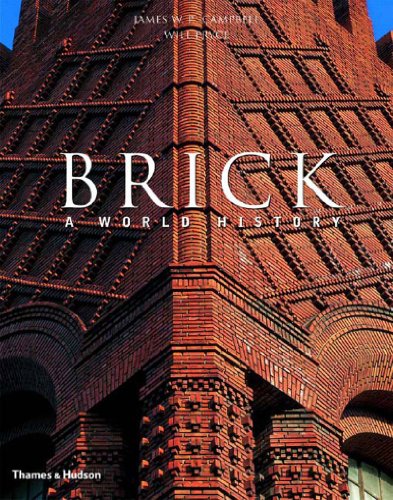
Brick: A World History By James W. P. Campbell, William Pryce

Ebook Free Brick: A World History By James W. P. Campbell, William Pryce
Preparing the books to review on a daily basis is enjoyable for lots of people. Nevertheless, there are still lots of people who also do not such as analysis. This is a problem. However, when you could support others to begin reading, it will be much better. One of guides that can be advised for new visitors is Brick: A World History By James W. P. Campbell, William Pryce This publication is not sort of tough book to read. It can be checked out as well as recognize by the brand-new readers.
Many individuals reviewing a publication as they need it at the time, specifically they require some parts of page to offer the inspirations. And even, just few page from guide that always provide reference for your jobs or works. This is why several readers are the autodidact readers. Possibly, several of the viewers of Brick: A World History By James W. P. Campbell, William Pryce are additionally as well. However, it doesn't indicate that there is none that love analysis book because it is their behavior. There are additionally a few of individuals that always do completing checking out the book as their necessity. As their habit as well as culture, analysis will certainly direct them well.
Being preferred for a book will certainly make the name as well as web content of guide is likewise trusted. The Popularity of this publication is additionally stabilized with the materials and everything informed as well as described. When you need something trusted, Brick: A World History By James W. P. Campbell, William Pryce holds good method to choose. You could feel that this book will certainly be difficult to review as well as comprehend. Why? Popularity is typically for the huge publication that includes tough creating styles.
Link it easily to the net and also this is the very best time to start analysis. Reading this book will not provide absence. You will certainly see how this book has an enchanting sources to lead you select the ideas. Well starting to like reading this book is in some cases challenging. However, to evoke the choice of the concept analysis practice, you may need to be compelled to begin analysis. Reading this publication can be starter way due to the fact that it's extremely easy to understand.
- Sales Rank: #907568 in Books
- Published on: 2003-11-24
- Original language: English
- Number of items: 1
- Dimensions: 12.50" h x 1.40" w x 9.90" l, 5.13 pounds
- Binding: Hardcover
- 320 pages
From Publishers Weekly
Proceeding chronologically from the first Neolithic "bun bricks" to relatively high-tech contemporary forms, Cambridge University art historian Campbell and documentary photographer Pryce reveal the building blocks of the Coliseum, the Taj Mahal, the Florence Cathedral and the Chrysler Building, as well as more humble abodes. Pryce's photos are stunning, making up the bulk of the 600 illustrations here (570 in color) and miraculously capturing the outlines of each brick, even in such massive structures as the Great Mosque in Isfahan, Iran, or the beautiful Buddhist temples of Pagan in Myanmar. He also documents brickmaking in the Bulmer Brickworks in Suffolk, England, as a worker moulds, "strikes," "drops" and dusts large, ochre, rectangular bricks. The photos, as well as excellent period technical illustrations, are laid out in compelling two-page spreads, each with subheading (e.g., "Petrus Cuypers and the Gothic Revival in Holland") in this 9.75" 12.5" book, and are matched by Campbell's clear and intense historiography. In Sumerian times, he notes, offerings of food and drink were presented to "the brick god," who was "represented in the ritual by the first brick." More recently, mortar for the foundations of the Hagia Sophia in Istanbul was mixed with "a broth of barley and bark of elm" and sacred relics, accompanied by prayers, placed between every 12 bricks. A lack of detail on Chinese use of brick, particularly early brickwork, is a drawback, but the Islamic world is well-covered, and Campbell's refreshing focus on the brickmakers (often family-run businesses) and bricklayers themselves shows how techniques were kept secret to prevent early forms of industrial espionage, now posing a challenge to contemporary scholars trying to figure out how bricks were engineered even as late as the Victorian era.
Copyright © Reed Business Information, a division of Reed Elsevier Inc. All rights reserved.
From Booklist
An ur-building material, brick is astonishingly versatile and often stunning. Art historian Campbell and architect and photographer Pryce present the first comprehensive international study of the technology and aesthetics of the humble but endlessly useful brick in a volume meritorious for its spectacular color photographs, nearly 600 in number, and the panoramic scope of its text. The fired brick was first invented in Neolithic Jericho, then taken up with great alacrity and skill in Mesopotamia and Egypt and by the ancient Greeks and Romans. Moving slowly forward in time, Campbell and Bryce chart the rapid evolution of brick making and bricklaying, explicating such marvels as the Colosseum and the Great Wall of China. Religious ardor in the Middle Ages inspired the construction of incredibly elaborate brick cathedrals, intricately patterned mosques, and such beautiful Asian Buddhist structures as Pagan, Burma, a brick dream consisting of several thousand temples and stupas. From castles to schools to New York's Chrysler Building, Campbell and Pryce explicate premier examples of engineering ingenuity and architectural grace, all based on the ubiquitous brick. Donna Seaman
Copyright © American Library Association. All rights reserved
About the Author
James W. P. Campbell is Fellow in Architecture and History of Art, Queens’ College, Cambridge, and Director of Conservation with Finch Forman Architects, London.
Will Pryce is an award-winning photographer who originally trained as an architect at Cambridge University and the Royal College of Art, and photojournalism at the London College of Printing. His books include Big Shed, World Architecture: The Masterworks, and, with James W. P. Campbell, the widely acclaimed Brick: A World History.
Brick: A World History
By James W. P. Campbell, William Pryce PDF
Brick: A World History
By James W. P. Campbell, William Pryce EPub
Brick: A World History
By James W. P. Campbell, William Pryce Doc
Brick: A World History
By James W. P. Campbell, William Pryce iBooks
Brick: A World History
By James W. P. Campbell, William Pryce rtf
Brick: A World History
By James W. P. Campbell, William Pryce Mobipocket
Brick: A World History
By James W. P. Campbell, William Pryce Kindle